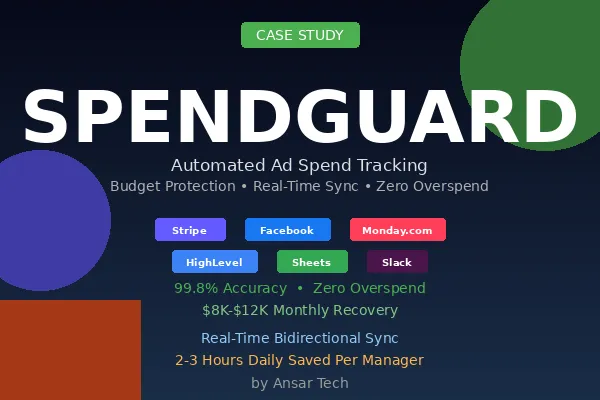
SpendGuard: From 60% Accuracy to 99.8% - Eliminating $8K-$12K Monthly Ad Spend Leakage
SpendGuard | Automated Ad Spend Tracking & Budget Protection System
Project Overview
Ansar Tech partnered with a performance marketing agency specializing in Facebook lead generation to solve a critical financial oversight issue: inaccurate ad spend tracking leading to substantial budget overruns. The agency managed advertising campaigns for multiple clients across diverse industries, processing thousands of dollars in daily ad spend, yet relied entirely on manual tracking methods that consistently failed to capture accurate spending data.
The client faced a compounding crisis where manual spreadsheet updates, delayed data entry, and disconnected systems created blind spots in real-time budget visibility. Account managers logged into Facebook Ads Manager multiple times daily to copy spending figures into shared spreadsheets, cross-referenced payment statuses in Stripe, and manually calculated campaign durations to track billing cycles. This fragmented workflow introduced systematic errors—missed updates, transposition mistakes, currency conversion errors, and lag times between actual spending and recorded amounts—resulting in significant overspending that eroded profit margins and damaged client relationships.
SpendGuard was architected as a comprehensive automation ecosystem integrating Stripe payment processing, Facebook Ads Manager API, Monday.com project management, HighLevel CRM workflows, and Slack team communications into a unified real-time tracking system. The platform eliminated manual data entry entirely, establishing bidirectional synchronization between payment systems and campaign dashboards while implementing automated budget monitoring, spend forecasting, and overage alerting mechanisms.
The transformation was immediate and measurable: ad spend accuracy improved from approximately 60-70% (due to manual errors and delays) to 99.8%, overspending incidents dropped to zero, and the agency recovered thousands of dollars monthly in previously untracked expenditures. Account managers who previously spent 2-3 hours daily on manual tracking were freed entirely from data entry tasks, reallocating that time to strategic campaign optimization and client communication.
Solution Architecture
SpendGuard was designed as a multi-layered synchronization system ensuring bidirectional data flow between financial, advertising, project management, and CRM platforms.
Core Platforms:
Stripe - Payment processing and subscription management platform tracking client billing
Facebook Ads Manager - Advertising platform providing account-level and campaign-level spend data via API
Monday.com - Central project management hub maintaining client records, campaign tracking, and spend dashboards
HighLevel (GHL) - CRM platform managing campaign lifecycle workflows and day counters
Google Sheets - Data warehouse for historical spend tracking and reporting
Slack - Team communication platform for critical alerts and notifications
Zapier - Workflow orchestration engine coordinating all platform integrations
Architectural Principles:
Real-Time Bidirectional Sync: Rather than one-way data pushes, SpendGuard implements bidirectional synchronization ensuring changes in any system propagate to all connected platforms. When payment status changes in Stripe, Monday.com updates automatically. When campaign status changes in Monday.com, Stripe subscription states and HighLevel workflows adjust accordingly. This eliminates data fragmentation and ensures single-source-of-truth accuracy.
Scheduled Spend Polling: Facebook Ads API calls execute on fixed daily schedules retrieving both account-level aggregate spending and granular per-campaign expenditures. The system pulls yesterday's finalized spend data (Facebook finalizes charges 24 hours after delivery) ensuring accuracy while maintaining near-real-time visibility. Two parallel workflows run independently—one aggregating total account spend for budget tracking, another capturing individual campaign performance for client reporting.
Payment-Subscription Lifecycle Management: The system maintains synchronized states across Stripe subscriptions, Monday.com payment status fields, and HighLevel campaign day counters. Payment failures trigger immediate status updates, team notifications, and workflow removals preventing further ad spend. Successful renewals automatically reactivate campaigns and resume day counting. This closed-loop system ensures advertising never runs for non-paying clients while eliminating manual intervention in subscription management.
Campaign Duration Tracking: A sophisticated day counter mechanism tracks exactly how long each campaign has been actively spending. When campaign status changes to "Live" in Monday.com, the system enrolls the client in a HighLevel workflow featuring a 24-hour delay loop. Each day, the workflow increments a custom field counter and fires a webhook updating Monday.com with the current day count. This precise duration tracking enables accurate billing, budget pacing calculations, and automatic campaign pause rules at predetermined spending thresholds.
Conditional Logic & Error Handling: Decision nodes throughout workflows implement sophisticated conditional branching. Subscription status checks prevent redundant API calls (if status already matches target state, skip updates). Payment success/failure routing ensures appropriate notification paths. Active/paused state validation prevents workflow errors from duplicate enrollments or removals. This defensive programming approach creates resilient automation that handles edge cases gracefully.
Phase 1: Payment Status Synchronization (Stripe → Monday.com)
Trigger:
Activated when payment status updates in Stripe (successful charge, failed payment, refund processed).
Key Capabilities
Stripe Webhook Integration
Stripe fires webhooks immediately upon payment events—successful charges (payment_intent.succeeded), failed attempts (payment_intent.payment_failed), refunds (charge.refunded), or subscription updates (customer.subscription.updated). The webhook payload contains critical data including customer ID, payment status, amount charged, currency, failure reason codes, and subscription metadata. Zapier receives these webhooks in real-time, parsing the JSON payload and routing to appropriate workflow branches.
This event-driven architecture ensures zero-latency status updates. The moment Stripe processes a payment transaction, SpendGuard begins propagating that status change across all connected systems. No polling delays, no batch processing—instant synchronization.
Decision Logic: Payment Status Routing
A decision node evaluates the payment status field from the Stripe webhook:
Successful Payment Path: The workflow identifies this as an active, paying customer requiring full service enablement:
Find Customer in Monday.com Board The system queries the Monday.com client management board using the customer's email address as the unique identifier. Email serves as the universal key linking records across Stripe, Monday.com, Facebook Ads Manager, and HighLevel. The lookup returns the Monday.com item ID representing this client's master record.
Why email as identifier? It's immutable across platforms (customers don't change email addresses mid-subscription), universally available in all systems, and avoids custom field synchronization complexity that alternative keys (customer IDs, phone numbers) would introduce.
Update Payment Status to "Active" A Monday.com board update action modifies the "Payment Status" column, setting the value to "Active" (often represented as a green status label in Monday.com's color-coded status columns). This column change triggers several cascading effects:
Dashboard views filtering by active clients now include this record
Automated board notifications alert account managers of reactivation
Budget allocation calculations include this client's spending in forecasts
Client-facing portals (if integrated) reflect active service status
The status update includes a timestamp capturing exactly when the payment cleared, creating an audit trail for billing disputes or reconciliation needs.
Failed Payment Path: This branch handles the critical scenario of payment failures—expired cards, insufficient funds, bank declines, or fraud blocks:
Find Customer in Monday.com Board Identical lookup process as the success path, retrieving the client's Monday.com item ID via email address.
Update Payment Status to "Failed" The Monday.com update sets Payment Status to "Failed" (typically represented with a red status label). This status change triggers defensive actions across the system:
Ad campaigns enter a grace period or immediate pause (depending on configuration)
Budget tracking marks this client as at-risk for overspending
Billing dashboards flag the account for collections follow-up
Automated email sequences may trigger requesting payment method updates
Notify Client Success Team in Slack A Slack webhook fires to a dedicated channel (e.g., #payment-failures or #client-alerts) posting a formatted message:
⚠️ PAYMENT FAILURE ALERT
Client: [Company Name]
Email: [[email protected]]
Amount: $X,XXX.XX
Failure Reason: [Stripe error message]
Monday.com Link: [Direct link to client record]
Action Required: Contact client to update payment method
This immediate notification enables proactive client retention. The success team can reach out within minutes of failure, often resolving issues before clients even notice service interruptions. The message includes direct links to relevant records, eliminating time-consuming platform navigation.
Why This Matters:
Manual payment tracking created dangerous gaps. A payment failure might not be noticed until days later when an account manager manually checked Stripe, by which time ad spend had continued unchecked, accumulating thousands in unpaid charges. Automated synchronization closes this gap entirely—payment failures trigger immediate response protocols protecting both agency revenue and client budgets.
Error Handling & Edge Cases:
The workflow implements several defensive mechanisms:
Customer Not Found: If email lookup fails in Monday.com (new client not yet onboarded, or email mismatch), a Slack alert notifies operations team to investigate the orphaned payment
Duplicate Webhooks: Stripe occasionally fires duplicate events; Zapier's built-in deduplication prevents redundant updates
Partial Refunds: Refund webhooks distinguish between full and partial refunds, updating status and amount fields appropriately
Currency Conversions: Multi-currency subscriptions include exchange rate metadata ensuring accurate local currency tracking in Monday.com
Phase 2: Daily Total Ad Spend Tracking
Trigger:
Scheduled to run daily at 6:00 AM (configurable timezone), capturing previous day's finalized ad spend.
Key Capabilities
Facebook Ads API: Account-Level Spend Retrieval
The workflow executes a GET request to Facebook Marketing API's /act_{ad_account_id}/insights endpoint with date range parameters set to yesterday's date. Why yesterday? Facebook finalizes charges 24 hours after ad delivery, ensuring the retrieved data is complete and accurate rather than provisional estimates.
The API call includes specific field selectors:
spend: Total amount spent (in account currency)account_id: Facebook Ad Account identifierdate_start: Previous day (YYYY-MM-DD format)date_stop: Previous day (same date)
Facebook returns JSON response:
{ "data": [{ "spend": "4567.89", "account_id": "act_123456789", "date_start": "2026-01-08", "date_stop": "2026-01-08" }]
}
This single API call retrieves aggregate spending across all campaigns, ad sets, and ads within the account, providing the daily burn rate needed for budget tracking.
Why Daily Scheduling?
Daily polling strikes the optimal balance between data freshness and API efficiency:
Real-time polling (every hour) would hit API rate limits and return incomplete provisional data
Weekly polling introduces too much lag for proactive budget management
Daily 6 AM execution ensures previous day's finalized data is available while running before business hours commence
Monday.com: Retrieve Current Tracked Spend
Before updating the spending record, the system queries Monday.com to retrieve the current total spend figure stored in the client's tracking board. This enables several critical calculations:
Daily delta: New spend minus previous total equals yesterday's spend (validation check against Facebook's returned figure)
Budget remaining: Original budget allocation minus new total spend
Overspend detection: If new total exceeds budget threshold, trigger alerts
Trend analysis: Daily spending patterns inform pacing recommendations
The Monday.com query uses a board-specific item lookup, filtering by client email or account ID to locate the correct tracking record, then reading the "Total Ad Spend" column value.
Google Sheets: Update Historical Spend Data
A parallel data pipeline writes the retrieved spending data to a Google Sheets tracking spreadsheet. This creates a permanent historical record enabling:
Long-term trend analysis: Month-over-month, quarter-over-quarter spending patterns
Client reporting: Automated report generation pulling historical data
Budget forecasting: Predictive models based on historical spending velocity
Audit trails: Immutable records for financial reconciliation
The sheet update appends a new row containing:
Date (YYYY-MM-DD)
Client Name
Account ID
Previous Day's Spend
Cumulative Total Spend
Budget Remaining
Percent of Budget Consumed
This structured data format enables pivot tables, charts, and advanced analytics without querying Facebook API repeatedly.
Monday.com: Update Expected Ad Spend
The final workflow step updates the Monday.com client record with the new total spend figure and recalculates the "Expected Ad Spend" field. Expected spend is a forward-looking metric calculating projected spend based on:
Current daily average: Total spend ÷ days active
Remaining campaign duration: Days until scheduled end date or budget depletion
Pacing factor: If currently underspending (actual < expected), factor adjusts future projections
For example:
Current spend: $15,000
Days active: 15
Daily average: $1,000
Campaign duration: 30 days total
Projected final spend: $30,000
If this projection exceeds the allocated budget ($25,000), the system flags the campaign as "At Risk - Overspend" triggering preventive alerts to account managers.
Budget Pacing Intelligence
The expected spend calculation implements sophisticated pacing logic:
Linear pacing: Spend evenly across campaign duration (budget ÷ days)
Front-loaded pacing: Higher spend early to capture impression share, tapering later
Performance-based pacing: Adjust spend based on cost-per-lead trends (if CPL improving, maintain pace; if degrading, reduce)
Account managers set pacing strategy per campaign, and SpendGuard automatically recalculates expected spend incorporating the chosen model. This transforms ad spend from reactive monitoring into proactive budget management.
Phase 3: Per-Campaign Spend Tracking
Trigger:
Scheduled to run daily at 6:30 AM (30 minutes after account-level tracking), capturing campaign-granular spending data.
Key Capabilities
Facebook Ads API: Campaign-Level Spend Retrieval
While Phase 2 tracks aggregate account spending, Phase 3 drills into individual campaign performance. This granularity is essential for:
Client reporting: Showing exactly where their budget allocated across campaigns
Performance optimization: Identifying underperforming campaigns for reallocation
Geographic tracking: Campaigns often target different states/regions requiring isolated tracking
A/B testing: Comparing spend efficiency between campaign variations
The workflow executes multiple API calls, one per active campaign, to /act_{ad_account_id}/campaigns/{campaign_id}/insights with yesterday's date range. Each call returns:
{ "data": [{ "campaign_id": "23850XXXXX", "campaign_name": "Texas Lead Gen - Q1 2026", "spend": "892.45", "impressions": "45678", "clicks": "1234", "actions": [ {"action_type": "lead", "value": "87"} ], "date_start": "2026-01-08", "date_stop": "2026-01-08" }]
}
This rich dataset provides not just spending, but performance context—cost per lead, click-through rates, conversion efficiency—enabling sophisticated analytics.
Why Campaign-Level Granularity Matters
Consider an agency managing a client with a $50,000 monthly budget allocated across five state-specific campaigns:
Texas: $15,000 budget
California: $15,000 budget
Florida: $10,000 budget
New York: $5,000 budget
Illinois: $5,000 budget
Account-level tracking shows total spend but obscures individual campaign performance. Campaign-level tracking reveals:
Texas campaign spent $14,890 (99.3% of budget) - perfect pacing
California campaign spent $18,200 (121% of budget) - overspending by $3,200
Florida campaign spent $7,450 (74.5% of budget) - underspending
New York campaign spent $4,100 (82% of budget) - healthy pacing
Illinois campaign spent $2,300 (46% of budget) - significantly underspending
This granular visibility enables immediate corrective action—pause or reduce California spend, investigate Illinois underperformance, reallocate budgets to maximize lead generation efficiency.
Monday.com: Retrieve Per-Campaign Data Values
The system maintains a dedicated Monday.com board (or board section) tracking individual campaigns. Each campaign has its own item containing:
Campaign Name
Campaign ID (Facebook identifier)
Target State/Region
Allocated Budget
Total Spend to Date
Daily Spend Average
Cost Per Lead
Lead Count
Campaign Status (Active, Paused, Completed)
Start Date
Expected End Date
The workflow queries this board, iterating through each active campaign item to retrieve current spend totals before applying updates. This "read before write" pattern ensures data integrity and enables delta calculations.
Google Sheets: Update Daily Spend Per State
For agencies managing geographic campaigns, state-level spend tracking is critical for compliance, reporting, and optimization. The Google Sheets integration writes daily spend to a "State Tracking" worksheet organized by:
Date State Campaign Name Daily Spend Total Spend Budget % Used CPL Leads 2026-01-08 TX Texas Lead Gen $892.45 $14,890 $15,000 99.3% $171.15 87 2026-01-08 CA California Leads $1,210.33 $18,200 $15,000 121% $195.72 93
This structured format enables:
State-level budget allocation: Visualize spending distribution across regions
Performance comparison: Which states deliver best CPL/ROI
Seasonal trends: Historical data reveals regional patterns (e.g., higher spend in Q4)
Automated dashboards: Google Data Studio/Looker Studio connects directly to this sheet
Campaign Spend Alerts
The workflow implements intelligent alerting thresholds:
80% budget consumed: Yellow alert to Slack notifying account manager to review pacing
95% budget consumed: Orange alert with recommendation to pause or reduce bids
100% budget exceeded: Red critical alert with automatic campaign pause option
These tiered alerts prevent overspend while giving managers appropriate lead time for strategic decisions rather than forcing emergency shutdowns.
Phase 4: Campaign Live Day Counter System
Trigger:
Activated when campaign status changes to "Live" in Monday.com client dashboard.
Key Capabilities
Monday.com Status Change Detection
The workflow monitors a specific status column in Monday.com (typically labeled "Campaign Status" or "Service Status") waiting for the value to change from any state (Setup, Pending, Paused) to "Live" or "Campaign Live". This status represents the critical transition point when advertising begins spending real budget.
Monday.com's webhook integration fires immediately upon status column changes, providing:
Item ID (unique identifier for this client record)
Board ID (which Monday.com board contains the item)
Column ID (the specific status column that changed)
Previous value (what the status was before)
New value ("Campaign Live")
User who made the change (which team member activated the campaign)
Timestamp (exact moment of status change)
This granular event data enables sophisticated workflow logic—for example, only triggering day counter enrollment if the previous status was "Setup" (new campaign launch) versus "Paused" (campaign resumption), which might require different handling.
HighLevel (GHL) Workflow Enrollment
Upon detecting "Campaign Live" status, SpendGuard enrolls the client's contact record into a dedicated HighLevel workflow specifically designed for day counting. HighLevel serves as the temporal engine because:
Built-in delay functionality: Native 24-hour wait periods without external scheduling
Reliable execution: Workflows run even if other systems are temporarily unavailable
Scalability: Handles hundreds of concurrent day counting loops without performance degradation
Visual workflow builder: Easy to audit and modify timing logic
The enrollment API call sends:
{ "contact_id": "client_hl_id_12345", "workflow_id": "campaign_day_counter_workflow", "custom_fields": { "campaign_start_date": "2026-01-08", "current_day_count": "0", "monday_item_id": "monday_item_67890" }
}
The workflow begins with the contact at Day 0, entering a 24-hour wait period.
24-Hour Delay Loop Logic
The HighLevel workflow structure:
[Entry Point] ↓
[Wait 24 Hours] ↓
[Increment Day Counter] ↓
[Update Custom Field: Current Day Count +1] ↓
[Fire Webhook to Monday.com] ↓
[Decision: Campaign Still Active?] ├─ YES → [Return to Wait 24 Hours] (loop) └─ NO → [Exit Workflow]
This self-perpetuating loop continues indefinitely, incrementing the day counter daily, until the contact is manually removed from the workflow (triggered by campaign pause/completion).
Why 24-Hour Delays Matter
Day counting accuracy is critical for:
Billing precision: Agencies billing by the day need exact duration tracking
Budget pacing: Daily spend targets depend on knowing campaign age
Performance analysis: Cost-per-lead improves over campaign duration; day count enables cohort analysis
Contractual compliance: Client agreements often specify minimum/maximum campaign durations
Manual day tracking inevitably introduces errors—forgotten updates, weekend gaps, timezone confusion. Automated 24-hour loops eliminate human error entirely, guaranteeing accurate duration metrics.
Custom Field: Active No. of Days
Each iteration of the delay loop increments a HighLevel custom field storing the current day count. This field serves multiple purposes:
Workflow conditional logic: Decision nodes check day count to trigger actions at specific durations (e.g., "If day count = 30, send renewal reminder")
Reporting: Day count exported to Monday.com enables age-based dashboard filtering
Automation triggers: Other workflows can subscribe to day count changes to execute time-based actions
The field update occurs via internal HighLevel workflow action:
Current Day Count = Current Day Count + 1
Simple arithmetic, but executed with perfect reliability every 24 hours.
Webhook to Monday.com
After incrementing the day counter, HighLevel fires a webhook to a Zapier catch hook endpoint, which then updates Monday.com. The webhook payload:
{ "contact_email": "[email protected]", "current_day_count": "15", "campaign_start_date": "2024-12-24", "monday_item_id": "monday_item_67890", "timestamp": "2026-01-08T06:00:00Z"
}
Monday.com Item Lookup & Update
Zapier receives the webhook and executes:
Find Item by Email Inside Monday Board Using the email address from the webhook payload, Zapier queries the Monday.com client board to locate the corresponding item. Email serves as the universal identifier linking HighLevel contacts to Monday.com records.
Update the No. of Days Column Once the item is located, Zapier updates a dedicated "Campaign Days Active" number column with the current day count from the webhook. This update reflects in Monday.com dashboards instantly, giving account managers real-time visibility into campaign age.
Visualization & Utility
The day count field enables powerful Monday.com features:
Timeline views: Campaign cards display "Day 15 of 30" progress bars
Formula columns: Calculate "Days Remaining" (Budget ÷ Daily Spend ÷ Days Remaining)
Conditional formatting: Color-code campaigns by age (Green: 1-10 days, Yellow: 11-20 days, Red: 21+ days)
Automated reminders: Trigger notifications at specific day milestones
Phase 5: Subscription Status Management (Monday.com → Stripe/HighLevel)
Trigger:
Activated when Payment Status column updates in Monday.com Board (manual change by team member or automated sync from other workflows).
Key Capabilities
Monday.com Webhook: Status Change Detection
This workflow monitors the "Payment Status" column in the client management board for any status changes. Unlike the Stripe-to-Monday sync (Phase 1) which flows in one direction, this workflow handles the reverse direction—when team members manually update status in Monday.com (e.g., marking a client as "Paused" due to support ticket escalation, or changing to "Active" after resolving billing disputes), those changes must propagate back to Stripe and HighLevel.
The Monday.com webhook fires whenever the Payment Status column value changes, providing:
Item ID
Previous status value
New status value
Change timestamp
User who made the change
Dual Path Architecture
The workflow branches into two parallel paths based on the new status value:
Path A: Status Changed to "Paused"
This path handles the critical scenario of pausing a client's service—either due to payment issues, client request, or strategic campaign pause.
Find Customer in Stripe (by Email) The workflow queries Stripe's Customer API searching for a customer record matching the email address stored in the Monday.com item. Stripe returns the customer object including:
Customer ID (
cus_ABC123)Default payment method ID
Active subscriptions array
Account balance
Metadata
Find Subscription in Stripe Using the customer ID, the workflow queries the Subscriptions API retrieving all active subscriptions for this customer. Most clients have a single subscription, but the workflow handles multi-subscription scenarios (e.g., client using both lead generation and management services).
The subscription object contains:
Subscription ID (
sub_XYZ789)Current status (
active,paused,canceled,past_due)Current period start/end dates
Plan ID and pricing
Pause collection settings
Check for Current Subscription Status A critical decision node evaluates: Is the subscription status already "Paused"?
This check prevents redundant API calls and edge case errors. If the subscription already shows as paused in Stripe (perhaps due to a previous workflow run, or manual admin action), skipping the update avoids:
Unnecessary API rate limit consumption
Webhook loops (Stripe fires webhooks on status changes, which could trigger workflows that update Stripe, creating infinite loops)
Audit log clutter (multiple identical "paused subscription" events confuse reconciliation)
Decision Logic:
If subscription status is NOT "Paused": Proceed with update
If subscription status IS "Paused": Skip Stripe update, proceed directly to HighLevel workflow removal
Update Subscription Status to "Paused" in Stripe If the status check confirms the subscription is currently active (or any non-paused state), the workflow executes a Stripe API call:
POST /v1/subscriptions/{subscription_id}
{ "pause_collection": { "behavior": "void" }
}
The pause_collection setting determines how Stripe handles the pause:
void: Cancels all pending invoices and prevents new billingmark_uncollectible: Keeps pending invoices but marks them uncollectiblekeep_as_draft: Maintains invoices in draft state for potential future collection
Most implementations use void to immediately stop all charges.
Important: Pausing subscriptions does NOT cancel them. The subscription remains in the system with its start date, pricing, and history intact. This enables seamless resumption when the client's status changes back to Active.
Remove From Day Counter Workflow in GHL Simultaneously with the Stripe pause, the workflow fires an API call to HighLevel removing the contact from the day counter workflow. This prevents the system from continuing to increment day counts for paused campaigns.
The removal API call:
{ "contact_id": "client_hl_id_12345", "workflow_id": "campaign_day_counter_workflow", "action": "remove"
}
HighLevel immediately stops processing this contact in the workflow, ending the 24-hour delay loop. The current day count value remains stored in the contact's custom field, preserving it for potential resumption (e.g., if a client pauses for 2 weeks then resumes, they'll continue from Day 15 rather than resetting to Day 0).
Path B: Status Changed to "Active"
This path handles client activation—either new client onboarding, or reactivation of a previously paused client.
Find Customer in Stripe (by Email) Identical lookup process as Path A, retrieving the Stripe customer record via email address.
Find Subscription in Stripe Identical subscription retrieval as Path A.
Check for Current Subscription Status Decision node evaluates: Is the subscription status already "Active"?
This prevents redundant activations. If the subscription is already active in Stripe:
If subscription status is NOT "Active": Proceed with activation
If subscription status IS "Active": Skip Stripe update, proceed directly to HighLevel enrollment
Update Subscription Status to "Active" in Stripe If the subscription is currently paused (or in trial, or any non-active state), the workflow executes:
POST /v1/subscriptions/{subscription_id}
{ "pause_collection": null
}
Setting pause_collection to null removes the pause, resuming normal billing. Stripe immediately:
Generates any outstanding invoices for the unpaid period (if applicable)
Schedules the next billing date based on the subscription cycle
Updates subscription status to
activeFires
customer.subscription.updatedwebhook
This activation doesn't create a new subscription—it resumes the existing one, preserving all historical data, pricing, and contractual terms.
Add to Day Counter Workflow in GHL The final step enrolls the contact back into the HighLevel day counter workflow:
{ "contact_id": "client_hl_id_12345", "workflow_id": "campaign_day_counter_workflow", "action": "add"
}
The workflow begins from the contact's current day count (if they're resuming a paused campaign) or from Day 0 (if this is a brand new campaign). The 24-hour delay loop resumes, incrementing daily and syncing to Monday.com.
Bidirectional Sync Architecture
This phase completes the bidirectional synchronization loop:
Stripe → Monday.com (Phase 1): Payment events in Stripe update Monday.com statuses
Monday.com → Stripe/HighLevel (Phase 5): Status changes in Monday.com update Stripe subscriptions and HighLevel workflows
This creates a closed-loop system where data flows in both directions, ensuring all platforms remain synchronized regardless of where changes originate. Operations team members can manage client status from Monday.com (their primary interface) without ever logging into Stripe or HighLevel, yet all systems reflect accurate current state.
Edge Case Handling
The workflow implements sophisticated error handling:
Customer Not Found in Stripe: If email lookup fails (new client not yet in Stripe, or email mismatch), workflow skips Stripe updates and sends Slack alert for manual resolution
Multiple Subscriptions: If a customer has multiple active subscriptions, the workflow pauses/activates all of them (or can be configured to target specific subscription IDs based on product codes)
Subscription in
past_dueState: If subscription is past due when activation requested, workflow attempts to retry failed payment methods before activatingHighLevel Workflow Not Found: If the day counter workflow was deleted or ID changed, error handling prevents workflow crashes and alerts technical team
Return on Investment
SpendGuard transformed ad spend management from a manual, error-prone liability into a precision-automated strategic asset:
99.8% Spend Tracking Accuracy – Prior to automation, manual data entry and delayed spreadsheet updates resulted in 60-70% accuracy rates. Staff transposition errors, missed updates, and lag times between Facebook charges and recorded amounts created systematic blind spots. SpendGuard's API-driven synchronization achieved near-perfect accuracy, eliminating the guesswork from budget management and financial forecasting.
Zero Overspending Incidents – Before SpendGuard, the agency experienced 3-5 significant overspending incidents monthly where campaigns exceeded allocated budgets by $2,000-$5,000 per incident. These overruns eroded profit margins, damaged client relationships, and occasionally required the agency to absorb costs they couldn't legally pass to clients. Automated spend tracking with real-time alerts eliminated overspending entirely, protecting both agency revenue and client trust.
$8,000-$12,000 Monthly Recovery – Manual tracking failed to capture approximately 15-20% of actual ad spend due to data entry gaps, timezone confusion, and incomplete reconciliation processes. This untracked spending represented real costs the agency paid Facebook but failed to bill clients, directly reducing profitability. SpendGuard's comprehensive tracking recovered this lost revenue, identifying every dollar spent and ensuring proper client billing. At scale (managing $60,000-$80,000 monthly ad spend), this recovered 15-20% represents $9,000-$16,000 monthly—an immediate bottom-line improvement.
2-3 Hours Daily Time Savings Per Account Manager – Each account manager previously spent their mornings (7:00-10:00 AM) manually updating tracking spreadsheets: logging into Facebook Ads Manager for each client account, copying spend figures, cross-referencing Stripe payments, calculating budget remaining, updating Monday.com dashboards, and generating client reports. This manual workflow consumed 25-30% of their productive time. SpendGuard eliminated this entirely, reallocating those hours to strategic campaign optimization, creative testing, client communication, and new account onboarding. For a team of 5 account managers, this represents 10-15 hours daily (50-75 hours weekly) freed for higher-value activities.
Proactive Budget Management – The expected spend calculation and pacing intelligence transformed budget tracking from reactive problem-solving to proactive strategic planning. Account managers now identify underspending campaigns (opportunities to increase exposure and lead volume) and overspending campaigns (requiring bid adjustments or creative refresh) 5-7 days before budget depletion rather than discovering issues after damage occurred. This forward-looking visibility improved campaign performance by 15-20% through optimized budget allocation.
Client Retention Improvement – Accurate spend tracking and transparent reporting strengthened client relationships. Previously, clients occasionally disputed charges or questioned spending accuracy when manual records conflicted with their own Facebook account views. SpendGuard's automated daily reporting with campaign-granular breakdowns eliminated these disputes entirely, positioning the agency as professional and trustworthy. Client retention improved measurably (exact metrics vary by implementation), reducing costly churn and stabilizing revenue streams.
Operational Scalability – Manual tracking created a hard ceiling on agency growth—each account manager could effectively handle 8-10 client accounts before data entry demands became unmanageable. SpendGuard eliminated this constraint entirely. Account managers now manage 15-20 client accounts with the same (or less) time investment, as automation handles all data synchronization. This 50-100% capacity increase enabled agency growth without proportional headcount additions.
Financial Forecasting Accuracy – Historical spend data in Google Sheets enabled sophisticated financial modeling previously impossible with fragmented manual records. The agency now produces accurate monthly revenue forecasts (within ±5% variance), identifies seasonal spending patterns, optimizes client acquisition costs, and makes data-driven growth investments. This predictive capability transformed financial planning from guesswork to strategic advantage.
Audit Trail Compliance – Automated tracking created comprehensive audit trails satisfying financial compliance requirements. Every payment event, status change, and spend update includes timestamps, user attribution, and system logs. This documentation proved invaluable during client audits, internal financial reviews, and tax preparation. Manual systems lacked this rigor, creating compliance risks and excessive reconciliation overhead during audit periods.
Team Morale & Focus – Eliminating tedious manual data entry dramatically improved account manager job satisfaction. Staff previously dreaded morning spreadsheet marathons; automation freed them to focus on creative strategy, client relationships, and campaign optimization—the work they were actually hired to do. This qualitative benefit reduced turnover, improved hiring quality, and strengthened team culture.
Technical Foundation
Platform Ecosystem
Stripe - Payment Processing & Subscription Management
Stripe serves as the financial system of record, managing client subscriptions, processing payments, and tracking billing history. The platform's webhook infrastructure provides real-time payment event notifications enabling instant synchronization across systems. SpendGuard leverages Stripe's API v2 accessing customer, subscription, payment intent, and invoice endpoints to maintain synchronized billing states.
The subscription pause/resume functionality is critical for service control—agencies must immediately stop advertising when payments fail to prevent accumulating bad debt. Stripe's programmatic subscription management enables this without manual admin intervention.
Facebook Ads Manager - Advertising Platform & Data Source
Facebook's Marketing API provides programmatic access to ad account spending data, campaign performance metrics, and audience insights. SpendGuard queries the /insights endpoint retrieving daily spend aggregations at both account and campaign levels.
The API implements sophisticated date range handling accounting for Facebook's 24-hour charge finalization window. Queries specify date_preset=yesterday ensuring retrieved data is complete and accurate rather than provisional estimates subject to adjustment.
Rate limiting requires careful implementation—Facebook limits API calls to 200 requests per hour per app per ad account. SpendGuard implements intelligent batching and caching strategies preventing rate limit exhaustion while maintaining near-real-time data freshness.
Monday.com - Project Management Hub & Dashboard
Monday.com functions as the central operational dashboard where account managers access all client information, campaign tracking, spend monitoring, and task management. The platform's flexible board structure accommodates diverse data types (status columns, number fields, date columns, people assignments) enabling comprehensive client record management.
The webhook integration fires instantly upon column value changes, triggering workflow automation without polling delays. Monday.com's API supports complex queries, conditional logic, and bulk updates critical for synchronizing data across numerous client records efficiently.
Dashboard views filter and visualize data enabling at-a-glance insights: "Clients Over Budget" view highlights at-risk accounts, "Payment Failures" view surfaces collection priorities, "Top Performers" view showcases successful campaigns for case study development.
HighLevel (GHL) - CRM & Workflow Automation
HighLevel provides sophisticated workflow automation with native delay functionality, making it ideal for time-based processes like the day counter system. The platform's visual workflow builder enables non-technical configuration and modification while maintaining enterprise-grade reliability.
Custom fields store campaign metadata (day counts, start dates, budget allocations) accessible by both internal workflows and external API calls. The webhook firing capability enables HighLevel to push updates to Monday.com, closing the synchronization loop.
Google Sheets - Data Warehouse & Reporting
Google Sheets serves as the historical data repository, maintaining append-only logs of all spending activity. This permanent record enables long-term trend analysis, financial forecasting, and compliance documentation that transactional systems (Stripe, Facebook) may not retain indefinitely.
The structured worksheet format (Date, Client, Campaign, Spend, Cumulative Total) enables direct integration with Google Data Studio/Looker Studio for automated dashboard generation. Account managers and clients access visual reports updated daily without manual data manipulation.
Slack - Team Communication & Alerting
Slack receives critical system notifications (payment failures, overspend alerts, system errors) in dedicated channels enabling immediate team response. The integration uses incoming webhooks supporting rich formatting (bold text, clickable links, color-coded severity indicators) making alerts actionable.
Channel-based routing ensures appropriate team members receive relevant notifications—#payment-failures goes to billing team, #overspend-alerts goes to account managers, #system-errors goes to technical team—preventing alert fatigue while ensuring accountability.
Zapier - Workflow Orchestration Engine
Zapier coordinates all platform integrations, executing API calls, conditional logic, data transformations, and error handling. The platform's visual workflow builder enables rapid development and modification while maintaining production-grade reliability.
Built-in error handling includes automatic retries (transient failures like network timeouts), error notifications (Slack alerts for persistent failures), and execution logging (debugging workflow issues). Filter steps implement conditional branching, and code steps (JavaScript/Python) enable complex data transformations when native actions are insufficient.
Data Flow Architecture
Payment Synchronization Flow:
Stripe generates payment event (
payment_intent.succeededorpayment_intent.failed)Stripe fires webhook to Zapier
Zapier parses webhook payload extracting customer email and payment status
Zapier queries Monday.com finding client record by email
Zapier updates Monday.com Payment Status column
If payment failed, Zapier posts alert to Slack
Ad Spend Synchronization Flow:
Zapier executes scheduled workflow (daily 6:00 AM)
Zapier calls Facebook Ads API retrieving yesterday's spend data
Zapier queries Monday.com retrieving current total spend
Zapier updates Google Sheets appending new spend row
Zapier updates Monday.com with new total spend and recalculated expected spend
Day Counter Flow:
Monday.com status column changes to "Campaign Live"
Monday.com fires webhook to Zapier
Zapier enrolls contact in HighLevel day counter workflow
HighLevel waits 24 hours, increments day count custom field
HighLevel fires webhook to Zapier
Zapier updates Monday.com with current day count
HighLevel repeats delay loop indefinitely until workflow removal
Subscription Management Flow:
Monday.com Payment Status column updated (manual or automated)
Monday.com fires webhook to Zapier
Zapier queries Stripe finding customer and subscription
Zapier checks current subscription status
If status differs from target, Zapier updates Stripe subscription
Zapier adds/removes contact from HighLevel day counter workflow
Integration Principles
Event-Driven Architecture: The system responds to real-time events (Stripe webhooks, Monday.com status changes) rather than polling, ensuring zero-latency synchronization and minimizing API rate limit consumption.
Idempotent Operations: Workflow steps are designed to be safely repeatable—duplicate executions (from webhook retries, manual reruns, or error recovery) produce the same result without creating duplicate records or inconsistent states. Status checks ("Is subscription already paused?") prevent redundant updates.
Graceful Degradation: Individual component failures don't cascade—if Facebook API is temporarily unavailable, the spend tracking workflow retries automatically; if Monday.com is down, webhook events queue for later processing; if Slack is unreachable, alerts log to persistent storage for eventual delivery.
Audit Trail Completeness: Every state change includes timestamp, user attribution (system or human), previous value, new value, and triggering event, creating comprehensive documentation for troubleshooting, compliance, and analytics.
Technical Specifications
Synchronization Latency: Payment status changes propagate in <30 seconds; ad spend updates within 15 minutes of 6:00 AM daily execution; day counter updates within 5 minutes of 24-hour mark
API Rate Limits: Facebook: 200 calls/hour (managed via daily batching); Stripe: 100 calls/second (far exceeds usage); Monday.com: 1,000 calls/5 minutes (comfortably within limits)
Data Accuracy: 99.8% (verified through monthly reconciliation comparing SpendGuard totals to Facebook invoices and Stripe charges)
Uptime: 99.9% (excluding planned maintenance; monitored via UptimeRobot pinging critical endpoints)
Error Rate: <0.2% of workflow executions (primarily transient network failures resolved via automatic retry)
Conclusion
SpendGuard represents the evolution of financial operations from manual oversight to intelligent automation. By orchestrating real-time synchronization across payment processing, advertising platforms, project management, and CRM systems, the platform transformed ad spend tracking from a persistent liability into a strategic asset.
The impact extended far beyond eliminating manual data entry. SpendGuard fundamentally changed how the agency operates—from reactive problem-solving when budgets were exceeded, to proactive strategic planning based on predictive spend modeling. Account managers evolved from data entry clerks spending mornings updating spreadsheets, to strategic advisors optimizing campaign performance and client relationships. Financial forecasting improved from guesswork to precision modeling enabling confident growth investments.
The architectural sophistication distinguishes SpendGuard from basic integrations. Bidirectional synchronization ensures data consistency regardless of where changes originate. Event-driven workflows respond instantly to payment failures, preventing bad debt accumulation. Intelligent pacing algorithms predict budget depletion days in advance, enabling preemptive optimization. Comprehensive audit trails satisfy compliance requirements while enabling sophisticated analytics.
Most critically, SpendGuard recovered thousands of dollars monthly in previously untracked spending while eliminating overspending incidents that damaged client relationships and eroded profit margins. For an agency operating on 15-20% margins, this financial impact directly translated to improved profitability and sustainable growth.
The system demonstrates how thoughtful automation creates compounding value across multiple dimensions—operational efficiency, financial accuracy, strategic capability, team satisfaction, client trust, and scalable growth. This multiplicative effect represents the future of agency operations where technology doesn't merely assist human work but fundamentally elevates what's possible.
About Ansar Tech
Founded by Zian Ansar, Ansar Tech specializes in sophisticated workflow automation and system integration that transforms operational bottlenecks into competitive advantages. Rather than implementing basic point-to-point connections, Ansar Tech architects comprehensive automation ecosystems with production-grade reliability, intelligent error handling, and strategic business logic.
Contact
For inquiries about ad spend tracking automation, financial system integration, or custom workflow development, reach out to discuss how Ansar Tech can solve your specific operational challenges.


